ANKLE ARTHRITIS TREATMENT MELBOURNE

Mr Troy Keith – MBBS (Hons), FRACS (Orth), FAOrthA

Mr Troy Keith

ANKLE ARTHRITIS TREATMENTS – A Patient’s Guide:

Mr Troy Keith – Orthopaedic Foot and Ankle Surgeon

“Ankle arthritis can cause pain, swelling and stiffness making everyday activities difficult. Treatment usually begins with non-surgical options such as pain relief, bracing and physiotherapy. If symptoms remain severe, surgical options may be recommended.”

0 Years
Over 23 years of surgical experience.
0 Years
7 years of specialist training.

Learn more about the key questions and answers in relation to Ankle Arthritis Treatments, by accessing the buttons below:

FREQUENTLY ASKED QUESTIONS

Visit our frequently asked questions section to find out common questions about ankle arthritis treatment including:

  • Can ankle arthritis be treated without surgery?

  • When should I see an ankle specialist or surgeon?

  • Is foot surgery covered by Medicare or private health insurance?

  • How long is the recovery time after ankle surgery?

  • Who is ankle surgery suitable for?

  • Can ankle arthritis return after surgery?

1. WHAT IS ANKLE ARTHRITIS?

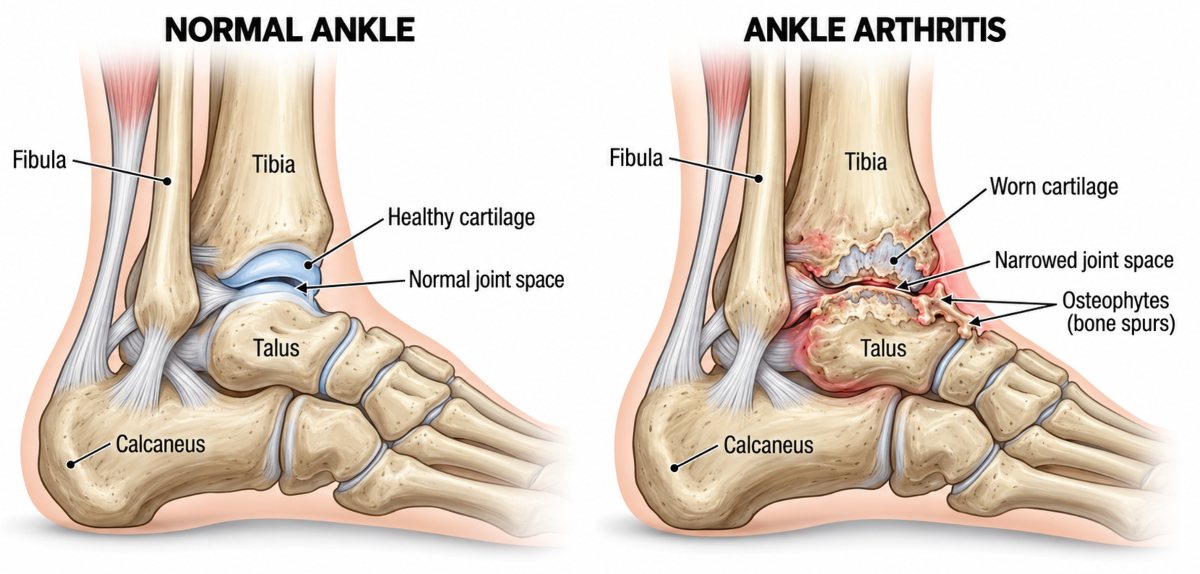
Definition – Ankle arthritis occurs when the smooth cartilage that protects the bones within the ankle joint becomes damaged or gradually wears away. Healthy cartilage allows the bones to move smoothly and helps absorb pressure during walking and other activities.

As the cartilage deteriorates, the joint surfaces may become rough and the space between the bones can narrow. This may cause ongoing pain, swelling, stiffness and reduced ankle movement.

Ankle arthritis treatments – Aim to reduce pain, improve mobility and help you remain active. Treatment usually begins with non-surgical options such as activity modification, supportive footwear, braces, physiotherapy and appropriate pain relief. If symptoms remain severe, surgery may include ankle arthroscopy, ankle fusion or total ankle replacement.

Mr Troy Keith, a Melbourne orthopaedic foot and ankle surgeon, will recommend treatment based on the severity of your arthritis, ankle alignment, general health and activity level.

Ankle Arthritis

Reference: American Academy of Orthopaedic Surgeons. (n.d.). Arthritis of the foot and ankle. OrthoInfo. Retrieved October 11, 2026, from www.orthoinfo.org/arthritis-of-the-foot-and-ankle/

2. TYPES OF ANKLE ARTHRITIS

The main types of arthritis affecting the ankle – See table below:

Type of arthritis Causes and symptoms
Osteoarthritis This develops when the protective cartilage covering the joint gradually wears down. As the joint surfaces become rougher and the space between the bones narrows, movement may become painful and stiff. Symptoms generally develop and worsen over time.
Post-traumatic arthritis This can develop following damage to the ankle joint, such as a previous fracture, repeated ankle sprains, infection or changes in joint alignment. Symptoms may appear years after the original injury.
Inflammatory arthritis Conditions such as rheumatoid arthritis and psoriatic arthritis can cause persistent joint inflammation and gradually damage the ankle.

Other factors that may contribute to ankle arthritis include:

  • Family history of the disease

  • Excess body weight can overload the ankle joint or worsen the symptoms of arthritis

  • Leg/ankle alignment – Anything which changes the leg or ankle alignment will alter the way the ankle is loaded and cause it to wear unevenly and more quickly (bow legs, knock knees or inverted ankles).

3. WHAT ARE THE CAUSES OF ANKLE ARTHRITIS?

Ankle arthritis develops when the smooth cartilage cushioning and protecting the ankle joint becomes damaged or worn. As this protective layer deteriorates, movement may become painful and the ankle can gradually lose flexibility.

Common causes and contributing factors include – See table below:

Ankle arthritis causes Description
Previous ankle injury A fracture, severe sprain or repeated ankle injuries can damage the cartilage and lead to post-traumatic arthritis, sometimes many years later.
Osteoarthritis Cartilage may gradually wear down over time. Although osteoarthritis becomes more common with age, it is less common in the ankle than in the hip or knee unless there has been a previous injury.
Inflammatory arthritis Conditions such as rheumatoid arthritis and psoriatic arthritis can cause persistent joint inflammation and gradually damage the ankle.
Ankle misalignment An unevenly aligned ankle can place additional pressure on one part of the joint, causing the cartilage to wear irregularly.
Joint infection An infection within the ankle joint can damage the cartilage and increase the risk of arthritis.
Excess body weight Carrying additional weight can increase pressure through the ankle and may contribute to worsening symptoms.
Mr Troy Keith

WHO IS PRONE TO ANKLE ARTHRITIS?

Anyone can get ankle arthritis. Osteoarthritis (degeneration or wear and tear) tends to become more common as we get older. Ankle trauma including fractures, repeated sprains, and inflammatory arthritis can cause arthritis at a younger age.

4. WHAT ARE THE SYMPTOMS OF ANKLE ARTHRITIS?

Ankle arthritis symptoms may vary depending on the cause and severity of the arthritis. They may develop gradually over time or become noticeable following an earlier ankle injury.

Common ankle arthritis symptoms may include – See table below:

Arthritis symptom Description
Pain Ankle pain is the most common symptom. It is often worse during walking, prolonged standing or other weight-bearing activities.
Joint stiffness The ankle may feel stiff or have a reduced range of movement. With inflammatory arthritis, stiffness may be more noticeable in the morning or after resting.
Swelling Fluid and inflammation within the joint can cause swelling. Changes to the bone and irritation of the surrounding soft tissues may also contribute.
Cracking, grinding or locking Rough joint surfaces or loose fragments of cartilage or bone may cause clicking, grinding, catching or locking sensations.
Weakness or giving way The ankle may feel unstable because of pain, muscle weakness, ligament damage or changes within the joint.
Difficulty walking Pain and stiffness may cause limping or make it more difficult to walk on stairs, slopes or uneven ground.
Reduced activity As symptoms progress, everyday activities, exercise and participation in sport may become increasingly difficult.
Mr Troy Keith

5. HOW IS ANKLE ARTHRITIS DIAGNOSED?

Mr Troy Keith – MBBS (Hons), FRACS (Orth), FAOrthA

Orthopaedic Foot and Ankle Surgeon.

Diagnosing ankle arthritis may include discussing your symptoms, medical history and any previous ankle injuries. Your surgeon will then examine the ankle to assess areas of pain, swelling, movement, stability and alignment.

A weight-bearing X-ray, taken while you are standing, may be recommended to show the joint space, changes to the bone and how the ankle responds when supporting your body weight.

Additional tests for ankle arthritis may include:

MRI scan – Provides detailed images of the cartilage and surrounding soft tissues. It may identify areas of cartilage damage or loose fragments within the joint.

CT scan or bone scan – May be recommended to assess the bones, joint surfaces and extent of the arthritis in greater detail.

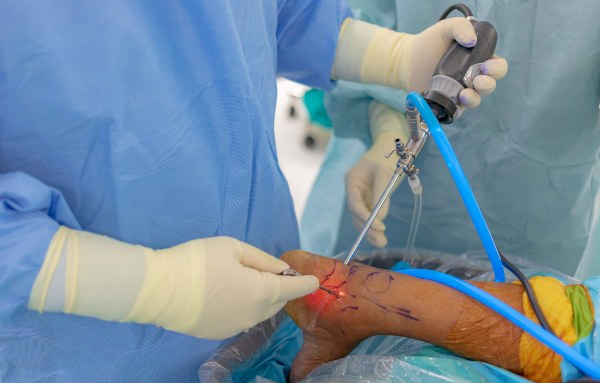
Ankle arthroscopy – An ankle arthroscopy is a keyhole procedure that uses a small camera to examine the inside of the ankle joint. It provides a detailed view of the cartilage and other joint structures and may help identify damage that may not be clearly visible on imaging scans.

Mr Troy Keith

ANKLE ARTHRITIS TREATMENT MELBOURNE

Once the cause and severity of your ankle arthritis has been determined, your surgeon will discuss appropriate treatment options with you. Non-surgical treatments are usually tried first, with surgery considered for more severe arthritis or when pain and reduced mobility affect daily life.

6. NON-OPERATIVE TREATMENTS FOR ANKLE ARTHRITIS

Non-operative treatments aim to reduce pain, improve movement and help you remain active without surgery. Your treatment plan will be tailored to your symptoms, lifestyle and the severity of your ankle arthritis.

Non-operative ankle treatments may include:

Activity modification – Reducing activities that aggravate your symptoms and allowing the ankle to rest during painful flare-ups.

Low-impact exercise – Activities such as swimming, cycling and hydrotherapy can help maintain strength and mobility while placing less stress on the ankle.

Physiotherapy – Targeted exercises may improve strength, flexibility, balance and walking function.

Supportive footwear – A firm, high-topped lace-up boot with a cushioned or rocker-style sole may support the ankle and make walking more comfortable.

Braces or splints – An ankle brace can reduce painful movement and provide additional stability.

Walking aids – A walking stick or other mobility aid may help reduce pressure on the ankle and improve balance.

Weight management – Where appropriate, maintaining a healthy weight can reduce the load placed on the ankle joint.

ankle arthritis ankle brace

Medication and specialist care – Paracetamol or anti-inflammatory medicines may help manage symptoms when appropriate. Check with your GP or pharmacist before using medicines or supplements, as these may cause side effects or interact with other treatments. People with inflammatory arthritis may also require rheumatologist care and disease-modifying medication.

7. SURGICAL TREATMENTS FOR ANKLE ARTHRITIS

Surgery may be considered when ankle arthritis causes ongoing pain, stiffness or reduced mobility that has not improved with non-operative treatment. The most appropriate procedure will depend on the severity and location of the arthritis, your ankle alignment, general health and activity needs.

Access the buttons below to find out more about ankle arthritis surgical treatment options:
Treatment Usually considered for Main purpose
(A) Ankle debridement Earlier arthritis with loose cartilage or bone spurs. Remove loose bodies and bone spurs to help relieve pain.
(B) Ankle joint fusion Severe arthritis where reliable pain relief is the priority. Permanently join the ankle bones to provide pain relief.
(C) Total ankle replacement Selected patients, often with lower physical demands. To provide pain relief and maintain some movement.

(A) ARTHROSCOPIC DEBRIDEMENT

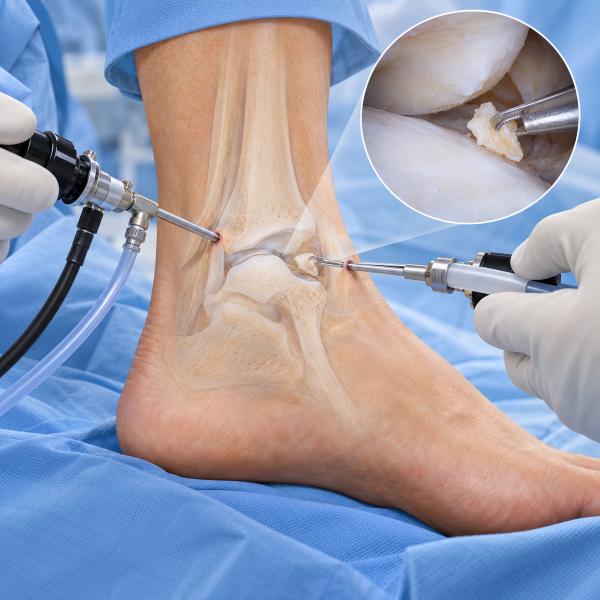
Arthroscopic debridement is a form of keyhole surgery that may be suitable for selected patients with ankle arthritis.

The procedure – Under anaesthetic, a small camera and specialised instruments are inserted into the ankle to allow your surgeon to examine the joint, and potentially remove loose pieces of cartilage or bone spurs that may be causing pain or restricting joint movement.

Potential results – Arthroscopic debridement does not restore damaged cartilage or cure ankle arthritis. However, it may reduce pain, stiffness and catching symptoms in selected patients.

Improvement varies in patients and symptoms may return as the arthritis progresses. Your surgeon will explain the benefits, limitations and risks of arthroscopic debridement and whether it is an appropriate option for you.

Visit – Potential risks and complications

Arthroscopic debridement

(B) ANKLE JOINT FUSION

Ankle fusion, also known as ankle arthrodesis, is a well-established treatment for severe ankle arthritis. It may be considered when ongoing pain and reduced mobility have not improved with non-operative treatments.

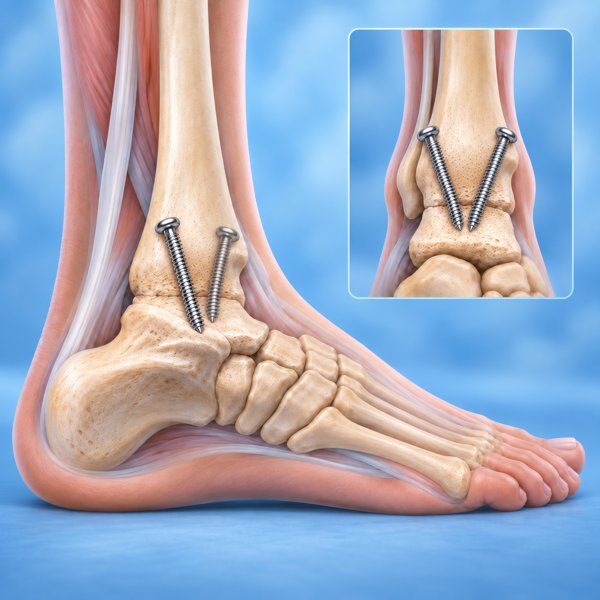
The procedure – During the procedure, the joint surface is removed and the bones of the ankle joint are permanently fixed with screws, allowing bone to heal across the joint. The bones then heal together, preventing movement through the arthritic joint.

Potential results – Ankle fusion is successful in approximately 96% of cases and can significantly reduce arthritis pain. Although the fused ankle joint no longer moves up and down, around 30% of the foot’s up-and-down movement comes from surrounding joints and usually remains after surgery. (Source: Cleveland Clinic)

How is ankle fusion surgery performed?

Ankle fusion may be performed using keyhole or open surgery, depending on the severity of the arthritis and the alignment of the ankle.

Keyhole ankle fusion – A small camera and surgical instruments are inserted through small incisions.

The damaged joint surfaces are prepared before screws are used to hold the ankle bones together while they fuse and heal.

Open ankle fusion – May be recommended due to significant deformity or the joint damage is more complex.

Through a larger incision, the damaged cartilage is removed, the ankle is realigned, and the bones are secured together with screws or plates.

A bone graft may also be used to support fusion and healing.

Visit – Potential risks and complications 

Ankle Joint Fusion

(C) TOTAL ANKLE REPLACEMENT

Total ankle replacement may be considered when advanced arthritis causes ongoing pain and reduced mobility despite non-operative treatment.

Who is suitable for a total ankle replacement – A total ankle replacement is generally recommended for carefully selected patients based on age, activity level, general health, bone quality, ankle alignment and joint stability. It is not intended to return young, athletic patients to full function.

It may suit older patients with lower activity demands, arthritis in both ankles or rheumatoid arthritis, particularly when other affected joints may not tolerate the added stress of ankle fusion. Mr Keith will assess your individual suitability.

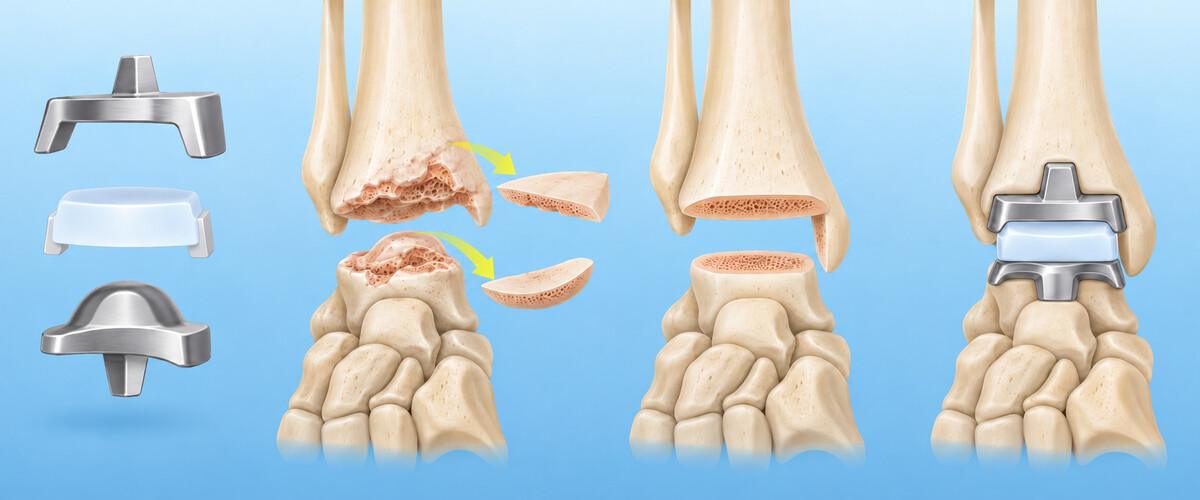
The procedure – The principle of the operation is to remove the worn out joint and replace it with a metal components on both the tibial (top) and talar (bottom) sides with a medical-grade plastic liner sandwiched between them allowing the ankle to move. The metal components are designed to bond securely with the surrounding bone.

total ankle replacement

Potential results – The procedure aims to relieve pain and improve existing movement. It may not increase your range of motion.

Approximately 80–90% of patients experience meaningful pain relief, and around 80–90% of ankle replacements remain functioning at 10 years. However, ankle replacements generally do not last as long as hip or knee replacements. (Source: Acta Orthopaedica)

Visit – Potential risks and complications 

8. POST-OPERATIVE CARE

After ankle fusion surgery or total ankle replacement surgery the following post-operative care and rehabilitation may take place over the next 6-12 months:

ANKLE FUSION PATIENTS

Your ankle will be protected in a below-knee plaster splint. During this time, you should:

  • Plaster splint – A plaster splint (worn for 2 weeks) is fitted in theatre during your procedure.
  • Elevate your leg – Keep your leg raised to help reduce pain and swelling.
  • Pain medication – Pain and swelling are expected after ankle surgery and are usually most noticeable during the first 3- 5 days. You will be given pain-relieving medication (both short and long acting medications)  to keep you comfortable.
    .
  • Avoid weight-bearing – Do not place any weight on the operated leg.

Most patients can leave hospital once they can move safely using crutches, a walker or knee scooter. At home, you should:

  • Avoid weight-bearing – Continue to keep all weight off the operated leg.
  • Elevate your leg – Keep your leg raised regularly to help manage swelling.
  • Protect your splint – Keep the splint clean, dry and securely in place.
  • Manage your pain – Take prescribed pain relief as directed.

Your wound and ankle will be assessed at your first follow-up appointment. This may include:

  • Suture removal – Your sutures may be removed and a below-knee cast fitted
  • Weight-bearing guidance – Mr Keith will advise whether you can begin placing weight through the leg while wearing the cast
  • Managing swelling – Continue to elevate your foot as required to help reduce swelling
  • Manage your pain – Take prescribed pain relief as directed
  • Rehabilitation – Rehabilitation begins gradually once your cast is removed. Physiotherapy may be recommended to improve strength, balance, mobility and walking. Your recovery efforts will help your increase your activity over time.

An X-ray will usually be taken to assess healing and the progress of the fusion. This appointment may include:

  • Cast review – Your cast will likely be removed at 6 weeks and potentiall replaced with another form of support.
  • Weight-bearing guidance – Your instructions will be updated according to your healing.
  • Rehabilitation – Further rehabilitation advice will be provided based on your recovery.

An X-ray will usually be taken to assess healing and the progress of the fusion. This appointment may include:

  • Weight-bearing guidance – Your instructions will be updated according to your healing
  • Rehabilitation – Further rehabilitation advice will be provided based on your recovery.

TOTAL ANKLE REPLACEMENT PATIENTS

After surgery, you will wake in the recovery room, where the nursing team will monitor you and help keep you comfortable. You can generally expect:

  • Plaster splint – A plaster splint (worn for 2 weeks) is fitted in theatre during your procedure.
  • Leg elevation – Your leg will be raised on pillows to help reduce pain and swelling
  • Blood-thinning medication – You may be prescribed a daily blood thinner to reduce the risk of deep vein thrombosis (DVT)
  • Pain medication – Pain and swelling are expected after ankle surgery and are usually most noticeable during the first 3- 5 days. You will be given pain-relieving medication (both short and long acting medications)  to keep you comfortable.
  • A specialised dressing – A negative-pressure dressing, such as a PICO dressing, may be placed over the wound. Leave it intact and follow your care team’s instructions.
  • Avoid weight-bearing – Do not place any weight on the operated leg.

Once you can move around safely using crutches, a walker or knee scooter, you will usually be ready to continue your recovery at home. Patients please note:

  • Leaving hospital – Most patients return home approximately 2–3 days after surgery
  • Avoid weight-bearing – Keep your operated leg completely off the ground and use your recommended mobility aid
  • Elevate your leg – Keep your leg elevated for around 23 hours a day to help control swelling and support wound healing
  • Protect your dressing – Keep your bandages clean, dry and intact until your two-week follow-up appointment
  • Manage your pain – Take prescribed pain relief as directed.

At your first review (two weeks after surgery) your wound and recovery will be assessed. This appointment may include:

  • Wound check and boot fitting – Your wound will be checked and a new dressing applied. Keep this dressing in place for another 72 hours. You will also be fitted with a removable walking boot, known as a CAM boot
  • Progress photograph – You may be asked to send a photograph of your wound one week later so the team can monitor its healing
  • Ankle exercises – You can begin gently moving your ankle out of the boot three times a day, following the instructions provided
  • Rehabilitation – Rehabilitation begins gradually once your cast is removed. Physiotherapy may be recommended to improve strength, balance, mobility and walking. Your recovery efforts will help your increase your activity over time
  • Weight-bearing – While wearing your boot, you can begin placing as much weight through the operated leg as you can comfortably tolerate
  • Showering – Once your wound has fully healed, you may shower. Always use a shower chair so you can sit safely.

At approximately six weeks after surgery, you will attend another review to assess your healing and recovery. This appointment may include:

  • X-ray and follow-up – An X-ray will be taken before your appointment to assess healing. A referral form will be emailed to you in advance
  • Transitioning out of the boot – With guidance from your physiotherapist, you will gradually move from the boot into supportive footwear and progress towards full weight-bearing
  • Rehabilitation – Further rehabilitation advice will be provided based on your recovery.
  • Supportive footwear – Examples of suitable shoes will be emailed to help you choose appropriate footwear.

Follow up x-rays will be advised to monitor the healing progress as well as:

  • Cast removal – Once the cast is removed, a compression or flight sock may help reduce swelling. It can take at least 6 months before the full benefits of surgery become apparent
  • Rehabilitation – Further rehabilitation advice will be provided based on your recovery.

Further review appointments may be scheduled at 6 and 12 months.

Rehabilitation – Rehabilitation usually begins during the first week after surgery, initially focusing on strengthening the hips and gluteal muscles. Physiotherapy may then help improve your overall strength, balance, mobility and walking, supporting a gradual return to everyday activities.

Longer term activities – In the longer term, most patients can return to activities such as walking and golf.  It is because of the reduction in ankle pain following  your surgery most patients find they no longer walk with a limp.

Shoe heel height – After recovery from surgery, the height of shoes you can comfortably wear may be limited, usually to heels below 3 cm. Some patients also find that shoes with a curved “rocker-bottom” sole make walking easier.

9. POTENTIAL RISKS AND COMPLICATIONS

As with all surgeries there are risks. The complications of an ankle fusion or replacement may include:

  • Infection and wound healing problems

  • Non-union – Failure of the bones to heal

  • Malunion – The bones not healing in the correct position

  • Prominent metalware – Screws may become uncomfortable and require removal, usually as a day procedure.

  • Blood clots

  • Nerve and blood vessel damage – This may lead to numbness, pain or weakness in the foot.

  • Adjacent joint arthritis – Following ankle fusion, additional stress on nearby joints may lead to arthritis, sometimes after 10 years or more.

  • Fracture of the ankle – Rarely, the bones around the ankle may fracture during surgery and require additional screws.

  • Wearing out of the plastic bearing – the plastic bearing in an ankle replacement may wear over time and is a common cause of failure after 10 years or more. Treatment may involve replacing the bearing or revising the ankle replacement.

  • Dislocation – This is rare with ankle replacement.

  • Failure of pain to resolve – This is usually due to one of the complications, but occasionally no cause is found.

Most problems may be treated by medications or in special circumstances further surgery but even allowing for these, sometimes a poor result ensues.

10. FREQUENTLY ASKED QUESTIONS

Ankle Arthritis Treatment Melbourne

Coverage depends on the procedure, your circumstances, Medicare eligibility and whether you have private health insurance. There may also be out-of-pocket costs associated with surgery, hospital care, anaesthesia, imaging or other services. The practice can provide information about fees and the relevant arrangements before treatment.

Consider seeking an assessment if ankle pain or stiffness persists, restricts walking or daily activity, causes recurring swelling, or has not improved with initial treatment. Earlier assessment may also be appropriate following a significant ankle injury or fracture.

Yes. Treatment commonly begins with non-surgical measures such as changing aggravating activities, supportive footwear, an ankle brace, physiotherapy, low-impact exercise and suitable pain relief. The recommended approach depends on the cause and severity of the arthritis.

After ankle fusion, arthritis cannot return in the fused joint because it no longer moves. However, additional stress may contribute to arthritis developing in nearby joints over time. After total ankle replacement, arthritis does not return in the replaced joint, but the implant can gradually wear or loosen and may eventually require further surgery.

No. Suitability depends on factors including age, activity level, ankle alignment, bone quality, ligament stability, general health and the condition of surrounding joints. A specialist assessment and weight-bearing imaging are usually required.

Ankle fusion permanently joins the bones of the ankle joint to reduce painful movement. An ankle replacement removes the damaged joint surfaces and inserts an artificial joint, with the aim of reducing pain while preserving some ankle movement. Not every patient is suitable for both procedures.

Recovery varies according to the procedure and the individual patient. A period of restricted activity, protective footwear or casting may be required, followed by progressive weight bearing and rehabilitation. Your surgeon will provide instructions specific to your operation.

Many people walk more comfortably after successful fusion because their arthritic pain is reduced. However, the fused ankle no longer moves normally, and walking pattern, footwear and participation in higher-impact activities may be affected.

Yes. We recommend you have a valid referral from your GP or specialist. Please ensure you are eligible for Medicare to receive your rebate from consults with Mr. Keith.

A Message from Mr Keith

These guidelines are intended to help you understand your treatment and prepare for your operation.

I understand the level of detail may cause concern or worry for some patients.

If you do have further questions, please don’t hesitate to ask me at your consultation or contact a member of my team.

We will happily address your concerns.

It is important for me that you feel comfortable and satisfied you have all the information you need before your surgery day.

Mr Troy Keith – MBBS (Hons), FRACS (Orth), FAOrthA Orthopaedic Foot & Ankle Surgeon.

Any questions please email

 Ankle Arthritis Treatment Melbourne:
Mr Troy Keith – Foot & Ankle Surgeon

If you have any questions or would like to make an appointment, please feel free to contact my team:

Ankle Arthritis Treatment Melbourne

Mr Keith sees patients from all over Melbourne to diagnose and treat ankle arthritis and ankle osteoarthritis. Mr Keith consults with patients from the following practice locations in Melbourne including Armadale, Heidelberg and Shepparton in country Victoria.